
Dry Eye Relief: The Truth About Artificial Tears, Preservatives & Propylene Glycol
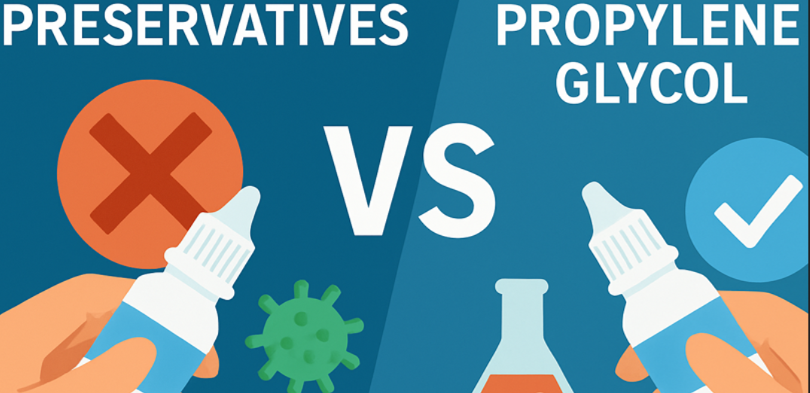
When it comes to artificial tear drops—commonly used to relieve dry eye symptoms—patients are increasingly curious and concerned about the ingredients inside the bottle. Two ingredients that often raise concerns are preservatives and propylene glycol, sometimes alarmingly referred to as “antifreeze.” We all know that many antifreeze solutions can be toxic to human consumption. In this article, we aim to clear up confusion, address safety concerns, and help you make informed decisions about your eye health.
Understanding Preservatives in Artificial Tears
What are preservatives and why are they used?
Preservatives are added to artificial tears to prevent bacterial contamination, especially in multi-use bottles. Eyedrop’s in multiuse bottles are sterile before opening, but after opening the tip can become contaminated. Without preservatives, these contaminated eye drops could become breeding grounds for harmful bacteria after being opened, posing a risk of serious eye infections.
Common preservatives in artificial tears include:
Benzalkonium chloride (BAK) – Effective but known to cause irritation or toxicity with frequent use.
Polyquad, Purite, or Sodium perborate – Gentler alternatives designed to break down into non-toxic components upon contact with the eye.
Are preservatives bad for your eyes?
Not necessarily. Preserved eye drops can be safely used for occasional relief. However, for patients with chronic dry eye or those who use drops multiple times daily, preservative-free options are often recommended to reduce the risk of irritation or damage to the ocular surface such as goblet cell deterioration which can damage in the mucous layer of your tear film.
Debunking the “Antifreeze” Myth: Propylene Glycol Explained
What is propylene glycol?
Propylene glycol is a common ingredient in artificial tears that acts as a lubricant and humectant, helping to retain moisture and soothe the eye’s surface. It is also used in many food, cosmetic, and pharmaceutical products. It’s proven to be safe for human consumption.
Why the confusion with antifreeze?
The misunderstanding arises because propylene glycol is also found in certain types of non-toxic antifreeze that you can buy for your car, giving rise to the myth that “antifreeze” is being put in your eye drops. In reality, the toxic component of antifreeze is ethylene glycol, which is not used in artificial tears or any approved medical product, and clearly not safe for human use.
Is propylene glycol safe for your eyes?
Yes. It is FDA-approved and has been safely used for decades in ophthalmic preparations. When used as directed, propylene glycol-containing artificial tears are effective and well-tolerated by most patients.
Making the Right Choice for Your Eyes
When choosing artificial tears:
For occasional use, OTC preserved drops are generally safe and generally more economical due to simpler bottle design and longer shelf life.
For frequent use or sensitive eyes, please opt for preservative-free formulations which are safer —often available in single-use vials or special bottles that prevent bottle tip contamination. Some examples include Hylo or Thealoz, which also includes a natural anti desiccant.
If you see propylene glycol on the label, rest assured—it is a therapeutic ingredient, not an industrial chemical in disguise.
Conclusion
The world of artificial tears can seem confusing, especially with alarming myths and fake news floating around online. Preservatives serve a purpose, and propylene glycol is a well-researched, safe ingredient—not harmful “antifreeze.” Always consult your eye care provider like your ophthalmologist to determine which drops are best suited for your specific condition.
Feel free to book your next eye check up HERE. Alternatively, You can call us at (604) 372-3937 for Surrey and (604) 853-5575 for Abbotsford.
Curious whether a procedure could work for you?
Book a free, no-obligation consultation with our team.
Keep reading
Medical-Legal Expertise for Ophthalmologists and Healthcare Professionals: Why the Right Expert Matters
Medicine is becoming increasingly complex. Even when a physician has acted appropriately and provided care consistent with accepted medical practice, complaints, College investigations, insurance…
Understanding Eye Pressure and Glaucoma
When it comes to protecting your vision, eye pressure is one of the most important measurements your eye doctor checks during a comprehensive eye exam. While…

What Are the Key Advantages of ICL Surgery?
For patients seeking freedom from glasses and contact lenses, Implantable Collamer Lens (ICL) surgery has become an increasingly popular vision correction option. ICL is…
What is the Difference Between a General Cataract Surgeon and a Refractive Cataract Surgeon
When people are told they need cataract surgery, one of the first questions that often comes up is: what kind of surgeon should I choose? That’s…